This post was written by Rory M., one of our summer students. Rory is a Music major at Brandon University.
When we consider what life was like in the Second World War, we often imagine the battles, uniforms, and equipment. However, behind every mission, training, and day overseas was something very important: a meal. As Napoleon said, “An army marches on their stomach.” Whether feeding airmen at home, civilian families, or armed forces overseas, food was fuel, and feeding many thousands with limited materials was no small task. A task, accomplished by a lot of potatoes and perseverance.
In the early years of the war, Armed Forces cooks were often inexperienced, and sometimes volunteers or drafted from within units. Some had some sort of food-related experience, but others were expected to learn very quickly on the job. Recognizing the importance of proper training was quickly acknowledged, as the RCAF opened the RCAF School of Cookery at RCAF Station Guelph, operating within the larger No. 4 Wireless School. Some topics that were covered in the school of cookery included food storage and sanitation, cooking in different environments, baking without ovens, and the minimization of rations and waste.

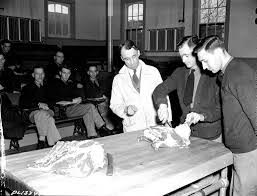
Instructional pamphlets, demonstrations, and supervisors in these schools helped improve the quality of the food across units, and according to a 1943 Canadian Government report, better training and standardization of practices increased morale and satisfaction, and reduced food complaints.
Meanwhile, civilians on the home front during the war were also dealing with their own food challenges. Many foods during the war were rationed – including sugar, coffee, meat, fats, butter, and eggs. This led to many innovative recipes and substitutions, including powdered eggs for eggs, potatoes for flour, vinegar for lemon juice, evaporated milk for milk, and margarine for butter. Soups and stews became common because they made the least amount of waste, and every peel, bone, and leftover was put to use. See attached at the bottom of this blog a recipe for a “chocolate wacky cake”, that uses no butter or milk, and tastes delicious!
Many commonwealth families stretched ingredients as far as they could, often turning to “war cakes” (reduced recipe meals) and meatless meals to get by. These creative substitutions didn’t just reflect resourcefulness—they became part of everyday culture during the war. Canadians also planted victory gardens – beds of fresh produce, including herbs, varying vegetables, and fruits.
While cooks worked to provide hot meals at home bases, food overseas was more limited and relied heavily on “field rations” and tinned goods. Allied and Canadian troops often received rations of canned corned beef, biscuits, canned veggies, processed cheese, jam, tea, and coffee. In combat zones, “composite rations” were issued, including boxed meals to feed a small group for 24 hours. Though not always entirely appetizing, they provided durability and nutrition. Occasionally, field kitchens were set up to cook hot meals, especially when Armed Forces members were stationed in the same place for a long period of time.
Reflecting on wartime meals reminds us not only of the adaptability of those who lived through this era but also of the sacrifices they made. These meals—simple, inventive, and often shared—tell a story of resilience. Today, many of the substitutions and recipes born out of necessity still appear in our kitchens. From community gardens to reduced-waste cooking, the lessons of wartime eating continue to shape how we approach food. Remembering these histories helps us better appreciate the abundance we often take for granted.
Recipe!
“Chocolate Wacky Cake” (allrecipes.com)
• 1 & 1/2 cups flour
• 4 Tbsp cocoa
• 1 tsp baking powder
• 1 tsp baking soda
• 1/2 tsp salt
• 1 cup white sugar
• 1 & 1/2 tsp vanilla
• 1 Tbsp vinegar
• 5 Tbsp veg oil
• 1 cup lukewarm Water
Preheat oven to 325°F.

6. Mix dry Ingredients together in one bowl, and wet ingredients together in another.
7. Add wet ingredients to dry ingredients and beat well with electric beaters, or stir well with a wooden spoon.
8. Bake at 325ºF for 45-50 minutes in an 8×8 ungreased pan.
9. Check with a toothpick before removing from the oven.
10. Allow to cool before frosting
 Commonwealth Air Training Plan Museum & RCAF WWII Memorial