This post was written by Rory M., one of our summer students. Rory is a Music major at Brandon University.
Upon the declaration of war by the British and subsequently, Canada, the beginning of the Second World War saw one of the most magnificent construction projects in Canadian history, the British Commonwealth Air Training Plan (BCATP). An ambitious and timely project, it included four commonwealth countries (Britain, Canada, Australia, and New Zealand). More than 130,000 aircrew were trained from across the world. Implementing the plan required the rapid construction of airfields, hangars, and living facilities in almost every Canadian province (note: Newfoundland was not yet a part of Canada). Here at the CATPM, our museum is home to one of more than 700 hangars that were built at this time, an engineering, bureaucratic, and planning success that ought to be celebrated. This begs the question: How did they do it? From conception to the opening of the schools, the completion timeline often took at most a mere 16 months, inconceivable in comparison to many of the 21st-century building obstacles, such as material costs, supply disruptions, permits, and economic uncertainties. For this blog post, I took a look at the early construction of the BCATP and the players who made it a miraculous feat of history.
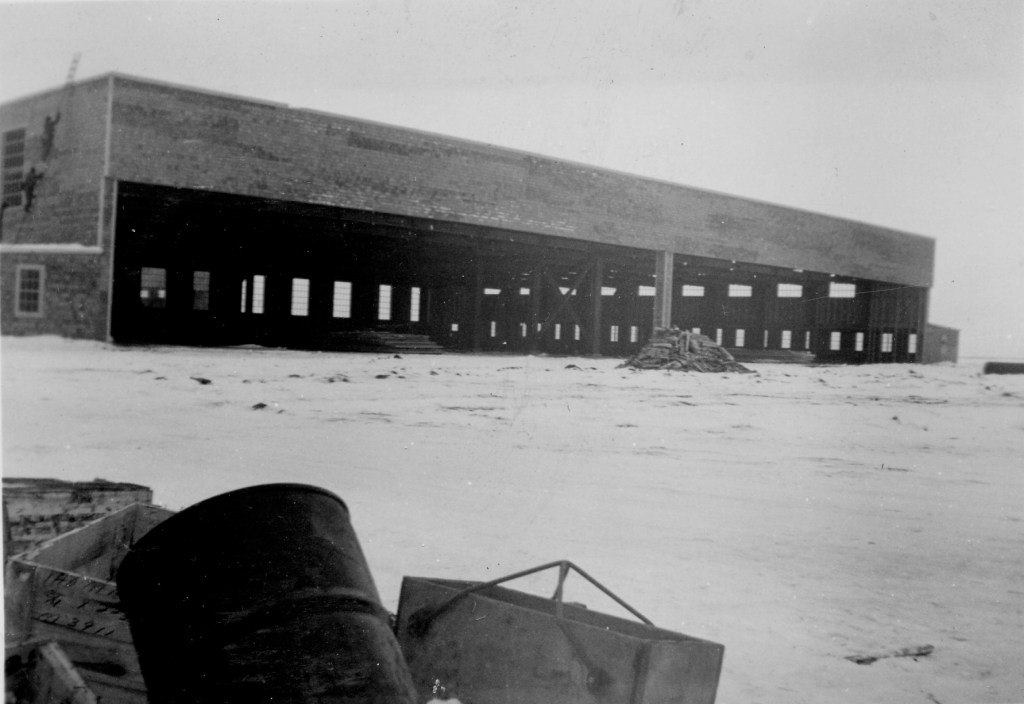
Our hangar at the CATPM, like many others from coast to coast, is constructed from Douglas fir, a large evergreen tree that is native to the West Coast. Known for its durability, resistance to rot (which we are thankful for as the museum ages), and straight grain, it quickly became the preferred material for wartime construction. Some Douglas fir trees can grow to become more than 250 feet tall and live for more than a thousand years. These trees were also very workable for the time because of their strong construction as timber, and therefore were chosen to build many hangars at the beginning of the war.

While many of the early engineers of the BCATP were members of the RCAF, the scale of the project was much larger, and therefore required a new organization for overseeing the project, called the “Directorate of Works and Buildings”. Leadership of this effort was led by a construction engineer from the Carter-Hall-Aldinger Construction Company of Winnipeg, who, from a crowded office in Ottawa, assembled a team of engineers and draftsmen that managed to produce more than 750,000 blueprints and 33,000 drawings, all facing the deadlines of wartime pressure.

The next step of site selection was a crucial step in the completion of the plan. At this time, the Department of Transportation (DOT) joined forces with the RCAF to evaluate suitable locations for airfields across the country that were required. To begin this process, field teams made up of a DOT inspector, RCAF representative, and engineer surveyed the land, and eventually proposed possible sites across the country. It is amazing to believe that in 1938, where the CATPM rests, there would have been an empty field where the museum now stands.
Once potential sites were approved, engineers began the practical design of dozens of standardized buildings – common among most schools of the BCATP. Including hangars, barracks, drill halls, offices, mess halls, and medical buildings, these common designs allowed for faster construction, including prefabricated or uniform parts to simplify construction. As one volunteer of the museum puts it, the construction of our hangar (like many others across Canada) was constructed methodically and uniformly, much like Ikea furniture.


Within the first two years of the plan (when the majority of schools were constructed), there were more than 7,000 buildings built, consisting of more than 1,000 construction contracts from coast to coast. This quick build, however, came at a steep cost, more than 80 million dollars in 1945 (equivalent to 1.5 billion today). While many often consider the hangars, barracks, and other buildings to be the most expensive parts of the plan, other infrastructure that we often take for granted was also very important. Heating systems, sewage, water lines, and roads were also needed, and in particularly dry areas like southern Saskatchewan, access to water could be a major challenge. To meet this need, more than 100 water pumping systems were constructed, and even some indoor swimming pools were built to store large amounts of water if needed. One of the obstacles in the engineering of the BCATP was that every school had its own geographic and resource challenges, so while most of the schools had many things in common, many had unique challenges and quirks.

Powering the schools posed another logistical hurdle. While many schools could draw electricity during the war from local utility companies, others (especially in remote areas) had to install their own diesel, steam, or gas-powered generators. To access natural resources at #12 SFTS in Brandon, a railway track had to be installed along the school, which also provided easy access for essential materials like aircraft fuel.
The runways themselves were another massive undertaking in the construction of the BCATP. While some existing airfields could be used for the Plan, the need for new training locations led to much construction. Under the oversight of the DOT, engineers built new runways, taxiways, parking aprons, and access roads. When completed, the paved runway accessed a miraculous 30 million square meters, roughly equaling a road totaling 4300 km of highway! This construction required a miraculous amount of filling of materials such as gravel, soil, and rock, as well as trudging through thick and formed mud, which served as one of the greatest challenges of the Plan. Many heavy-duty vehicles were used to clear the mud, including the 1938 Industrial tractor in the hangar of the CATPM, and only once the mud could be cleared could much of the building of infrastructure for the Plan begin.
Today, the massive size and speed of the construction of schools in the BCATP stands as a testament to the dedication and genius that many Canadians provided to jump-start the war effort. Through engineering genius, political action, force and direction, the BCATP ought to be celebrated as a pinnacle of Canadian excellence in construction and innovation. While many of the buildings had a 5-year temporary design in mind, many (including the CATPM’s) Douglas fir hangar have endured as lasting reminders of the meticulous excellence that helped build the “Aerodrome of Democracy” from the ground up.
 Commonwealth Air Training Plan Museum & RCAF WWII Memorial
Wonderfully well written Rory!
Barb
LikeLike