A guest blog post by summer employee, Seraphina Gilbert. We asked Seraphina to write a few posts about her favourite displays, this is her first post.
During WWII, the Canadian home front was a surprisingly busy place as the country responsible for much of the munitions and vehicle manufacturing. Canada was also home to the British Commonwealth Air Training Plan, which was used to train RCAF, RAF, RAAF and RNZAF troops. Over 230 of these training sites were located across the country and once they were established the Canadian skies became filled with striking, yellow aircraft.
Canada and it’s BCATP became known as “The Aerodrome of Democracy” and it became one of the greatest strengths for the Allied forces. It allowed for people to train for all necessary jobs overseas and on the home front. Every person had a part to play and every job, no matter how seemingly minute or irrelevant, was important to the war effort. One such person was a man named Jack Taylor, and he was a barber.
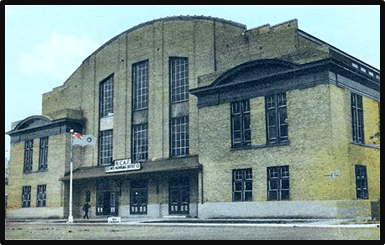
Brandon, Manitoba was home to the #2 Manning Depot, one of the 7 locations that enlistees would go to. Enlistees would be examined by a medical officer as well as receive multiple vaccinations (often all in the same arm!) at these depots. This is also where they would do basic training and receive their kits, which was their uniforms and standard issue items. The Air Force also had strict regulations on the way troops could style their hair. Many troops got haircuts before arriving to the depot and were forced to get another one to be up to standard. One second aircraftsman even said “I had a haircut the day before I got here. And within two weeks I’ve had five!”. It was Mr. Jack Taylor who kept the barbershop running for thousands of haircuts.
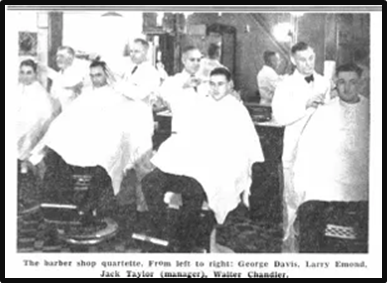
Little biographical information has been found about John (Jack) Taylor, though we know he was born in Carmen in 1905 and that he married his first and only wife, Gilberta, in 1924. They also welcomed their daughter and only child, Lyle, in 1928. When the war started, Jack joined the RCAF and started working in the manning depot in his hometown, Brandon. He worked as the barbershop manager and he had three other men working under him, George Davis, Larry Emond and Walter Chandler. Aside from cutting hair, Jack did another amazing thing. Jack asked every person who came through his shop to sign a book with their name, rank, registration number, and where they’re from.
We’re unsure of why he did this, but utterly grateful that he did. He started collecting signatures early on in 1941, and by the end of the war he had collected over 22,000. The vast majority of these were signed by the end of 1942 as training began to slow down after that point. On the other hand, there are still many signatures that were done from 1943 and onwards. After looking through the signatures, people of over 32 different nationalities had signed the book. There are countries, included but not limited to Ireland, Jamaica, Czechoslovakia, Spain and South Africa. People from all over the world had ended up in Jack’s chair at one point or another.

The Barber’s Book isn’t a literal book but rather a large stack of scribblers. After the war, the book stayed with Jack and his family. Jack went on to open his own barbershop here in Brandon and it was located where Samson Engineering Inc is today, only a short walk from his place of residence. While he did this, his wife Gilberta was working as a teacher at Park School here in Brandon and their daughter worked as a nurse. It was likely that Lyle learned how to nurse during the war, but little biographical information has been found about her as well. Jack retired from work in 1968, and he and his wife moved away from Brandon sometime in the ‘70s. The Barber’s Book was donated by Jack in the ‘80s, shortly before his death.
The Barber’s Book has been apart of the Commonwealth Air Training Plan Museum’s collection for almost as long as the museum has existed. Everyday at least one person comes to the museum and flips through the pages, looking at the signatures of the past. People often have us search through (a digitized version) in order to find relative’s signatures. The Barber’s Book has been an incredibly useful aid for people’s general research, genealogy tracing as well as people who are just curious about their family’s history. Even children on field trips have gotten to see their great-grandfather’s signature in the book. It has brought people together in so many ways and has helped people piece together their own past. Jack Taylor’s collection of signatures shows that even one small action can make a huge impact.

Written by Seraphina Gilbert


My father served in the Military Police from 1941-45 and was posted at bases in Quill Lake and Weyburn, Saskatchewan, Winnipeg, Manitoba and Hagersville, Ontario which is near Hamilton where I was born in 1944. My mother was a nurse and often worked at the local hospitals in these communities. She often spoke of Boomtown which was the name given to a collection of granary buildings converted into cabins to accommodate married couples as there was no accommodation for them on the bases. She often spoke of the many couples who became fast friends and of the parties and dances they had. Has anyone else heard of this Boomtown housing solution or have any pictures of this time?
LikeLike
Thanks for the comment, Dan. I have heard of the term, but not in this context, I will ask some of the more knowledgeable folks around here. I have been through many thousands of our archival images and do not recall seeing anything like this. I wonder if these ‘villages’ were put up quickly to house the married couples so were called boomtowns?
LikeLike