This post is by summer student worker, Whitney M. Hodgins is a Master of Arts Student from Athabasca University.
Author’s note: I would like to acknowledge and thank Greg Bartlett, a former Canadian Forces firefighter, for peer reviewing this article and taking the time to provide their expertise to this piece to ensure accuracy of content.
One of our most interesting artifacts (in my biased opinion), is huddled in a blue display case inside the hangar of the Commonwealth Air Training Plan Museum. At first glance it looks like a frumpy off-white suit, with a tiny window for the wearer to peak out of. When you look at the artifact’s tag you quickly realize why it is encased in a display case that has no ability to be opened by anyone without the right equipment. The tag reads “Asbestos Fire Suit”.
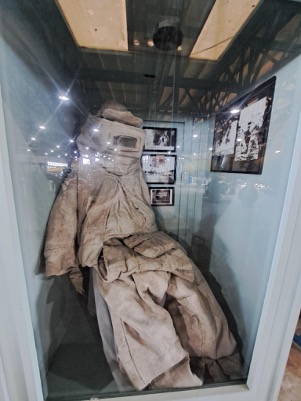
(in a special safe enclosure).
Asbestos is the general name for six related naturally occurring minerals that are fibrous and silicone-based (PSAC, 2022). The three main kinds of Asbestos are chrysotile, amosite, and crocidolite (PSAC, 2022). Prior to WWII and even as recently as the 1990s, many manufactured items and building materials were created using asbestos because it was both heat resistant and fire resistant (PSAC, 2022). This suit inside the museum was one example of asbestos being used in war-time by fire-fighters to protect them from fires where extreme heat and the possibility of a fire reflash could occur (DC Museum, 2026). A reflash, or flash fire known by some, is when all combustible materials in a space ignite simultaneously (Kiurski, T., 2010). Although many items may have different temperatures of ignition, it is when the heat rises so rapidly that it creates a flashover (Kiurski, 2010). Flash fires occur when oxygen and fuel meet a heat source and combust (Sanchez, 2019). Oftentimes, this means that the heat is too extreme for most regular fire equipment to last more than a few seconds even by modern fire protective equipment standards (Kiurski, 2010). The asbestos suits were a past solution to a problem where it would allow emergency grounds crews the ability to have more time to actually do their jobs which in the RCAF was rescuing pilots from plane crashes. However, it is important to remember that more time does not mean infinite time, as crash crews who responded to extreme fires from aircraft crashes only had three minutes to get there, save the pilot, and avoid total loss of the aircraft (Museum of RAF Firefighting, 2026).
Every RCAF base had its own ground crews that had a fire brigade and everyone had to be trained to put out fires, a tradition that is still current even at the Brandon Municipal Airport (Hayter, S. 2026). These fire-fighters were assigned to a crash-crew, and they had to put on these suits whenever a plane would take off or land (Hartle, 2019). Their primary role was not necessarily putting out the fires that would occur, but more so they had the role of getting pilots out of the burning aircraft (Hartle, 2019). In addition to having breathing apparatus’ and oxygen tanks strapped to their backs, they would also have a bag of small tools with them (Hartle, 2019). These tools allowed the firemen the grim responsibility to free a pilot from the aircraft by either extracting pilots through the windows or amputating limbs that may be caught or crushed in the plane if needed (Hartle, 2019; Museum of RAF Firefighting, 2026). At the No. 12 Service Flying Training School here in Brandon, Manitoba, only two fires involving aircraft occurred since its inception in 1941 (Library Archives of Canada, 2026). Neither involved extraction or amputations (LAC, 2026). They had other fires they attended that were not aircraft related, but overall, the crash-crews here in WWII were not facing such grim situations.
Like most manufactured items that were the precursors to modern equipment and technology we have today, there are some design issues with the suit that are important to make note of. Firstly, the suit did not burn but it was able to conduct heat (DC Museum, 2026). This means that fire fighters in these suits were wearing them and fighting blazes for a very limited amount of time (DC Museum, 2026). In order to address this limitation, there would have needed to be multiple fire fighters who could switch out with one another in order to contain any blaze that occurred (DC Museum, 2026). In addition to the time limitations, there are legitimate risks for the wearer of this suit. If the suit got saturated with water when conducting their duties, the heat and water could scald the person wearing the suit (DC Museum, 2026). Additionally if the suit got wet from steam, the wearer would need to switch out and find a cool place to avoid getting overheated (DC Museum, 2026). But there was also a silent killer that existed with this suit and that is the material itself.
Asbestos may not have hurt service members in the moment, but long-term it impacted the health of many people who come in contact with asbestos regardless of their occupation or what branch of the military they were serving in. How this occurs is that fibres from the asbestos are inhaled by the individual wearers and over time they can create a health condition known as mesothelioma (PSAC, 2022). Mesothelioma is a type of cancer that lines the membranes of the lungs in the human body (PSAC, 2022). It can also cause irreversible damage called asbestosis, which is scarring of the lung tissue caused by the asbestos fibers damaging the tissues (PSAC, 2022). This is what makes this suit so sinister; because it not only draws attention to what RCAF members would wear to fight fires in WWII, it also is showcasing bravery for servicemembers dangerously dressed.
To see what a simulated rescue from one of these crash crews looks like, watch this video linked here: https://www.youtube.com/watch?v=FQzSjDQLSaw

