Special Event: Jazz in the Hangar!

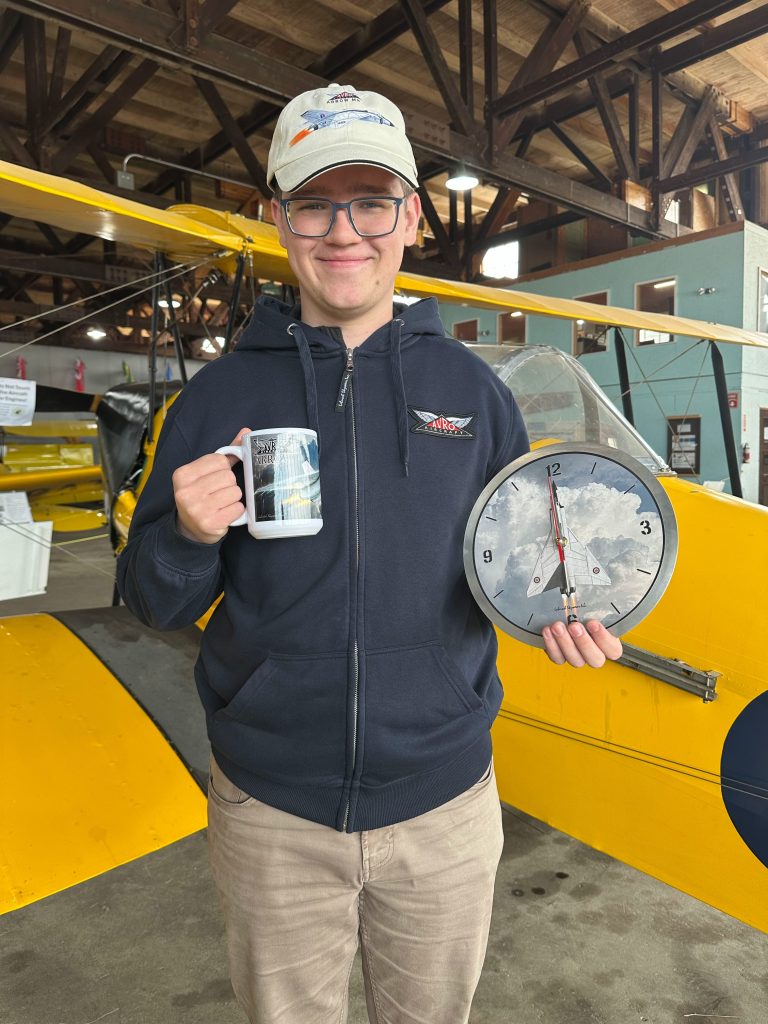
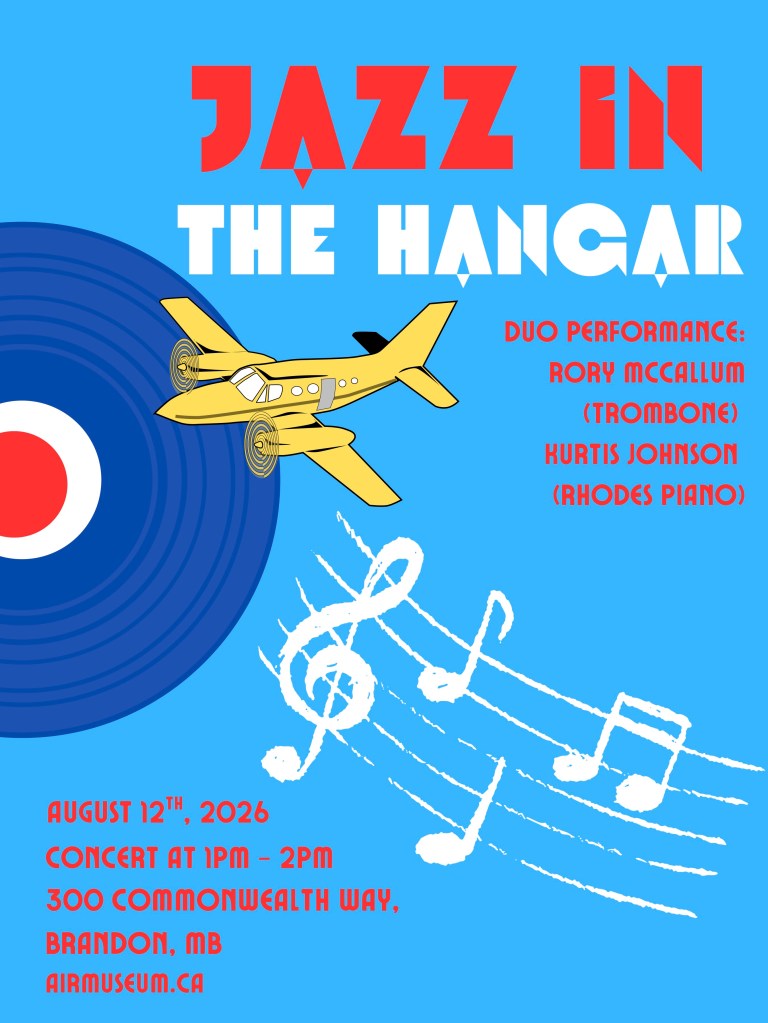
This coming August 12th from 1 – 2 pm, one of our summer student workers, Rory, and his fellow music student, Kurtis, will give a free (with admission) concert in the hangar! Surrounded by historic aircraft, experience an afternoon where music and history come together in an unforgettable way. Read a bit more about this duo below.

Rory McCallum (Trombone) and Kurtis Johnson (Piano) are current students and graduates from the Brandon University School of Music. Performing instrumental music in the jazz and contemporary popular music realm, they draw on jazz traditions and contemporary perspectives, using improvisation and interaction in familiar and standard repertoire. Together, these musicians have had the pleasure of performing in Manitoba and Saskatchewan, including the Cork and Bone Dinner Specials in Moosomin, SK, the Onanole Foundation Art Auction in Onanole, MB, the Brandon University Jazz Festival and other private and corporate events

Dangerously Dressed: RCAF Fire Suits of WWII

This post is by summer student worker, Whitney M. Hodgins is a Master of Arts Student from Athabasca University.

Author’s note: I would like to acknowledge and thank Greg Bartlett, a former Canadian Forces firefighter, for peer reviewing this article and taking the time to provide their expertise to this piece to ensure accuracy of content.

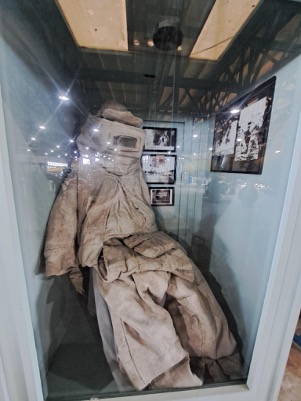
One of our most interesting artifacts (in my biased opinion), is huddled in a blue display case inside the hangar of the Commonwealth Air Training Plan Museum. At first glance it looks like a frumpy off-white suit, with a tiny window for the wearer to peak out of. When you look at the artifact’s tag you quickly realize why it is encased in a display case that has no ability to be opened by anyone without the right equipment. The tag reads “Asbestos Fire Suit”. 

The museum’s asbestos fire fighting suit
(in a special safe enclosure).

Asbestos is the general name for six related naturally occurring minerals that are fibrous and silicone-based (PSAC, 2022). The three main kinds of Asbestos are chrysotile, amosite, and crocidolite (PSAC, 2022). Prior to WWII and even as recently as the 1990s, many manufactured items and building materials were created using asbestos because it was both heat resistant and fire resistant (PSAC, 2022). This suit inside the museum was one example of asbestos being used in war-time by fire-fighters to protect them from fires where extreme heat and the possibility of a fire reflash could occur (DC Museum, 2026). A reflash, or flash fire known by some, is when all combustible materials in a space ignite simultaneously (Kiurski, T., 2010). Although many items may have different temperatures of ignition, it is when the heat rises so rapidly that it creates a flashover (Kiurski, 2010). Flash fires occur when oxygen and fuel meet a heat source and combust (Sanchez, 2019). Oftentimes, this means that the heat is too extreme for most regular fire equipment to last more than a few seconds even by modern fire protective equipment standards (Kiurski, 2010). The asbestos suits were a past solution to a problem where it would allow emergency grounds crews the ability to have more time to actually do their jobs which in the RCAF was rescuing pilots from plane crashes. However, it is important to remember that more time does not mean infinite time, as crash crews who responded to extreme fires from aircraft crashes only had three minutes to get there, save the pilot, and avoid total loss of the aircraft (Museum of RAF Firefighting, 2026). 

Every RCAF base had its own ground crews that had a fire brigade and everyone had to be trained to put out fires, a tradition that is still current even at the Brandon Municipal Airport (Hayter, S. 2026). These fire-fighters were assigned to a crash-crew, and they had to  put on these suits whenever a plane would take off or land (Hartle, 2019). Their primary role was not necessarily putting out the fires that would occur, but more so they had the  role of getting pilots out of the burning aircraft (Hartle, 2019). In addition to having breathing apparatus’ and oxygen tanks strapped to their backs, they would also have a bag of small tools with them (Hartle, 2019). These tools allowed the firemen the grim responsibility to free a pilot from the aircraft by either extracting pilots through the windows or amputating limbs that may be caught or crushed in the plane if needed (Hartle, 2019; Museum of RAF Firefighting, 2026). At the No. 12 Service Flying Training School here in Brandon, Manitoba, only two fires involving aircraft occurred since its inception in 1941 (Library Archives of Canada, 2026). Neither involved extraction or amputations (LAC, 2026). They had other fires they attended that were not aircraft related, but overall, the crash-crews here in WWII were not facing such grim situations.

Like most manufactured items that were the precursors to modern equipment and technology we have today, there are some design issues with the suit that are important to make note of. Firstly, the suit did not burn but it was able to conduct heat (DC Museum, 2026). This means that fire fighters in these suits were wearing them and fighting blazes for a very limited amount of time (DC Museum, 2026). In order to address this limitation, there would have needed to be multiple fire fighters who could switch out with one another in order to contain any blaze that occurred (DC Museum, 2026). In addition to the time limitations, there are legitimate risks for the wearer of this suit. If the suit got saturated with water when conducting their duties, the heat and water could scald the person wearing the suit (DC Museum, 2026). Additionally if the suit got wet from steam, the wearer would need to switch out and find a cool place to avoid getting overheated (DC Museum, 2026). But there was also a silent killer that existed with this suit and that is the material itself. 

Asbestos may not have hurt service members in the moment, but long-term it impacted the health of many people who come in contact with asbestos regardless of their occupation or what branch of the military they were serving in. How this occurs is that fibres from the asbestos are inhaled by the individual wearers and over time they can create a health condition known as mesothelioma (PSAC, 2022). Mesothelioma is a type of cancer that lines the membranes of the lungs in the human body (PSAC, 2022). It can also cause irreversible damage called asbestosis, which is scarring of the lung tissue caused by the asbestos fibers damaging the tissues (PSAC, 2022). This is what makes this suit so sinister; because it not only draws attention to what RCAF members would wear to fight fires in WWII, it also is showcasing bravery for servicemembers dangerously dressed. 

To see what a simulated rescue from one of these crash crews looks like, watch this video linked here: https://www.youtube.com/watch?v=FQzSjDQLSaw

A Few of My Favourite Things

This post is by summer student worker Seraphina. This is their third summer with us. Seraphina is a recent Music School graduate (Brandon University) and will soon be heading to Ottawa at the end of summer to do a Masters program at Carleton University.

This is my final summer at the Commonwealth Air Training Plan Museum after three years of working here and it has been a very eventful period of my life. I have done a variety of different things while here such as working the front desk, archival maintenance and cataloguing, and responding to a large number of research requests. I have also researched and designed an exhibit for the CATP Museum (hopefully to be developed soon) as the final project for one of my senior history courses at Brandon University. I’ve also mowed the lawn — once. They haven’t asked me to do it since, so clearly, lawncare is not my strong suit; I tend to gravitate towards work that keeps me inside and relatively clean. Though, that being said, I have been known to crawl under vehicles and aircraft from time to time. I have done a little bit of everything while here, but there are few things in particular that hold a special place in my heart.

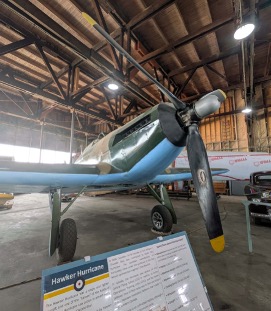
One of my favourite parts of my job is getting to be a tour guide. I enjoy working with and am comfortable touring around any age group; I remember once having to tour a kindergarten class and then turn around and tour a retirement home afterwards. That being said, I’ve always enjoyed touring young kids the most. There’s always a level of excitement and child-like wonder that you can’t find anywhere else. I love answering questions too, and kids, well, they have lots of them. There’s plenty to see in the museum but touring in the hangar is almost always a little bit magical in a way. Kids are absolutely fascinated by the planes and love to learn about the differences between the aircraft. From the Tiger Moth to the Harvard and even to our Hurricane, there is always something exciting to learn about. The best part though, is telling kids that some of our planes still fly. It just completely blows their minds, sometimes they don’t even believe me. It’s always such a joy.

And the fact that the planes still fly, is one of my other favourite parts of the job. Every couple of weeks in the summer the museum offers rides to the public in some of our airworthy aircraft. We have pilots and ground crew who volunteer their precious time to come and work with our planes, simply because they love it. They work together to make an unforgettable experience for those who come to sit in hour planes. During these days, I’ve gotten the opportunity to help with work behind the scenes managing bookings and the schedule, as well as with waivers and other general organization. Typically, I try to do everything in my power to make the crew’s lives easier and to make the day run smoother. It may not come with the same glory as actually flying one of the planes but I’m more than happy to help out where I can. It means a lot to me that I’m able to help get our passengers up in the air. Seeing the joy on their face when they come back through the museum after a flight is more than fulfilling enough for me.

On July 1st this year, on top of offering rides, a few of our planes also participated in Canada Day fly pasts, both at Winnipeg Beach and here in Brandon. I was doing my usual work until it was mentioned to me that there was an extra seat in our Harvard Mk. II during Brandon’s fly past. I was told that it was taking off in twenty minutes and I had the choice on whether or not I wanted to go. Obviously I said yes. Truthfully, during my time here the Harvard hasn’t interested me all that much. While I do talk about it during my tours, I mainlt use it to discuss the uses of mounted gun cameras during the war, since the Harvard was equipped with the system. While I don’t want to undermine what truly an incredible plane the Harvard is, I’ve just always felt more drawn to some of our other aircraft like the Tiger Moth. Still, I said yes. I’ve never had the opportunity to go in one of our planes before and I absolutely wasn’t going to turn it up.

The CATPM’s Harvard (with Sera aboard) during the July 1 Canada Day Flyover.
The Harvard returns from a flight on July 1, 2026.

After a very quick safety briefing I was strapped into the plane for take off. Immediately I was so captivated by the internal pulley systems moving inside of the plane, that I didn’t even bother to look out through the canopy. I’ve always described these planes as giant marionettes and after finally the plane in action, I was happy to finally know that my descriptor was accurate.  I’ve always loved roller-coasters and G-Forces, so I had no issue with the take-off or flight itself. If anything, I actually found the experience somewhat relaxing. Most of the time I was up there, I was completely fixated on the beautiful view around me. I grew up in Rivers and so Brandon was always the “big city” for me growing up. Although I’ve only actually started living here in recent years (and will be moving away soon), Brandon always has and always will hold a special place in my heart. I’ve explored so much of the city by foot on the ground and so it was incredible to get to see a birds eye view of it.

It was a really incredible opportunity for the chance to get out the office for a bit and take a ride in our Harvard. All of our planes are beautiful, and I would’ve been happy to ride in any of them, but I am really happy it worked out the way it did. Prior to getting inside that plane, I didn’t have any connection to it, but when I stepped out of it, that had all changed. It was now the plane that showed me home in a brand new light; it also gave me almost a sense of closure just before I have to move at the end of the summer. I get to see and talk to everyone after they get back from their rides, and I’ve seen the many different emotions and reactions that came from it — most typically excitement and exhilaration. For me, it was just this deep feeling of peace and calm. Then, after we landed, it was right back to work doing exactly what I love to do. Just like that, an aircraft that was once just one of many in our collection to me, became something that I will forever hold close to my heart.

Sera’s view on her special flight in the Harvard!

Ron Mallet & His Accordion

This post, his second for us, was written by Rory M., one of our summer students. Rory is a Music major at Brandon University.

Note: This article was posted originally last year, however, it is being re-posted with a correction.

Musical instruments across the world carry memories of their players, and the history that they have endured. As a musician myself for most of my life I have always been amazed especially by the story of the instruments in my family; including my 1926 Markneukirchen church violin that was used through the war in a German church near the Czechia border, the 1955 King 3B trombone that was produced and later refurbished by the H.N. White Company in Cleveland Ohio, 1964 Fiddle that belonged to my great-grandfather who played in dance bands across Manitoba, and my great-uncle Malcolm’s Manhattan trumpet, that was transported back to my family following his death in the RCAF as a navigator in 1943. 

Another instrument that always caught my eye during my time thus far as a summer student was the accordion in the personal item section of the main gallery. The accordion is a beautiful work of art and identifiable of Italian origin, and the only identifying information surrounding the accordion is “Soprani”, and an archival tag for our museum. While some staff had an idea of the origin of the instrument and the story of the gentleman who owned it during the war, there was no clear consensus on the exact owner. Following a search in the archives we were able to obtain a series of letters sent in the span of 1941-1942, by RCAF Pilot Officer Ronald Mallett.

His instrument, an E Soprani Accordion is a brand of accordion founded in 1910 in the central Italian town of Castelfidardo. These instruments quickly gained an excellent reputation before the war for their quality of tone and high standard of workmanship. The same traditional production techniques of these instruments have been handed down through the generations of master instrument makers, and are made largely the same in 2025 as they were in the 30s when Ronald would have purchased his instrument. Today, these instruments are still produced in Castelfidardo.

Ronald Mallett was born on October 8th, 1919 in Elkhorn, Manitoba to parents Fred and Agnes, and had three siblings, Amy, Albert, and Clifford. Following his secondary education at Elkhorn Collegiate, he attended the Chicago School of Air Conditioning and Refrigeration, where he later found employment at the Canada Car and Foundry in Fort William, ON. Ron was working in Fort William until joining the Canadian Army, where he served and trained in Shilo from March to June of 1941. His service in the army then ended when he transferred to the RCAF and began right here in Brandon; attending #2 Manning Depot in Brandon beginning on June 27th, 1941. He is in fact in Jack Taylor’s Barbers Book in the CATPM’s main gallery (see previous blog post on August 30th, 2024), in which he is on page 59 of book 1. Another connection that Ronald has to our museum is that he flew in both the Fairey Battle and Avro Anson, two aircraft that are either in progress or on static display in the CATPM. Following his time in Brandon, Mallett then attended Initial Training School (ITS) in Edmonton where I found a first confirmation of his playing of his accordion, in a letter to his sister Amy.

Thanks for the sheet of music, It arrived today and I’ll practice it tonight. I have been playing it by ear, but this will help me correct my mistakes. If I continue to get chances to practice at the next station I am going to have a lot of nice pieces to play for you and Joyce to dance to. I bought a book of swell tunes at Saskatoon and have spent quite a little time on them. Yes, I play from taps, also the Boys Good-bye, Apple Blossom Time, Good-bye Dear, I’ll Be Back in a Year, and a few more of the popular ones.

(Ron Mallet, November 4th, 1941, to sister Amy Forsyth, ITS in Edmonton, AB)

The sheet music for “Apple Blossom Time” by the Andrews Sisters; a popular singing group of the swing era, can be found in the personal items case along with the accordion, and prior to the letters we found, we were not aware that the two items were related to the same man! Following ITS in Edmonton, Mallett attended training in Saskatoon (Secondary Flying Training School), Portage (Air Observer School), and made his final stop in Canadian air training in Canada, at Paulson MB’s Bombing and Gunnery School.

On the Wed. night of the final week at Portage, we had our Flight Party and it was a huge success. I chorded and led the tunes for the sing-songs and certainly enjoyed myself. The C.O. cracked down and gave us all a surprise by leading much of the singing as well as giving us a few choice English solos.

(Ron Mallett, February 23rd, 1942, to Family, B&G School in Paulson, MB)

While the extent of Ron’s accordion performance in the RCAF was not formally sponsored, I was able to observe from his letters that his accordion was an avenue for recreation, relaxation, and collective enjoyment among other service members. Ron also had other expertise on other instruments and played both harmonica as well as piano on some of the bases in which he trained. Following the completion of his training, Ron headed overseas to England, where he finished his training in various English sites, including a Personnel Reception Center in Bournemouth, and an Operational Training Unit in Wellesbourne. 

In his letters during this period, Mallett speaks of greater free time after his training for recreation and enjoyment. Throughout this time in England, he spent his day meeting new people through various dances (including mentions of meeting a 22-year-old nurse with whom he attended many) as well as watching films in theatres throughout his time in England. One question, however, remained as months in England passed; how come there is no reference to him playing any accordion in dances or his free time on base? Following further reading of letters home for many months, clarification was provided in a letter dated August 7th, 1942, about three months before his passing. 

Sadly I’d like to be home this weekend to spend the day and morrow with you folk, and the night. Just to get my hands on that accordion again, would be quite a thrill in itself especially at this station where we quite have a couple of hours in the evening.

This provided the way that Ron Mallett’s accordion ended up in the hands of the CATPM; it was sent back to Elkhorn to his family following his training in Canada. While we assumed that similarly to my great-uncle’s trumpet it was shipped home following his passing, it never left Canada. Following this letter, Ron spent the remainder of his time preparing for action in various training units, and passed away in a mission over Wellesbourne along with two other Canadians in a Wellington Mark III, on November 30th, 1942. Mallet was posthumously promoted to Flying Officer and was honoured by his Group Captain Commanding as the “very finest type of young man upon whom we are relying to win the war, and I need hardly tell you that he was extremely popular with everyone here. His keenness on his job and his enthusiasm for everything he took in hand were most marked.

The most important lesson that I draw from the observation of artifacts in the museum is to remember that while every artifact portrays a part of the larger whole of war, they are additionally remnants of young people who grew up in our communities. As we remember the stories of artifacts like the accordion and young men like Ronald Mallett, it is important to remember just as Romanian-American holocaust survivor Elie Wiesel offered, “When you listen to a witness, you become a witness.” The further that we are removed in time from conflicts that affected our history and the freedoms that we observe today, we must not grow desensitized from the tragedy of war; especially as we see hatred and disregard for human life in many ways across the globe. I am grateful for the opportunity to observe history under the access of the CATPM, additional thanks to mallettfamilyhistory.org, for clarifying certain details of his life.  

Mandates and Serial Plates

This post is by our summer student, Seraphina. Sera has been with us 3 summers now and is heading to Ottawa at the end of summer to do a Masters program at Carleton University. She has written several blog posts for us over the past 2 years.

When it comes to museums, the primary focus is often on the artifacts in both the public exhibits and in the archives. What kind of artifacts? How many? How old? The questions go on and on. I know whenever I go to a museum, it’s the artifacts that I look forward to seeing the most (I often also try to get tours of the archives when I can). Every museum is different and their collections are all determined by their mandate — this is the museum’s purpose; it explains why the museum exists and what it collects. Mandates can be broad or specific, or anywhere in between, and here at the Commonwealth Air Training Plan Museum we have a very explicit mandate. While a full explanation can be found on our website, generally, our mandate can be summed up to the following: We collect and preserve objects with a direct relation to the British Commonwealth Air Training Plan between the years of 1939 and 1945.

We collect and preserve objects with a direct relation to the British Commonwealth Air Training Plan between the years of 1939 and 1945.


Like most museums, what you see in our galleries is only a small fraction of what we’ve actually collected. We have fairly extensive archives and we’re receiving new donations almost daily. Many of these donations are done through direct communication with the museum and through that we’re able to get an understanding of that object’s history. So when we receive these items, we already know that they fit our mandate. Sometimes, however, we receive a few wayward donations — objects mysteriously dropped at our door. When this happens, we have to do some research in order to be sure that they’re related to our museum. If they fit, we take them, if not, we reach out to find a museum or archive that can. Similarly, we find old items from the museum’s early days stashed away in storage and they need to be re-catalogued according to our modern standards. When this occurs, like with our mystery donations, we do some background research in order to determine if it’s something our museum should keep.

Sometimes this process is as simple as looking at the date on a letter, other times the process is much more complicated. It’s especially so when it comes to old machinery and power equipment. Doing the background research on some of the equipment is one of the ways I’ve helped out around the museum. Originally, during my first summer here, I was tasked with doing some research on our ground vehicles in order to make sure that our signage was up to date. This project not only piqued my interest, but it sparked my love of historical research. While doing this work, I started to become very familiar with not only Vehicle Identification Numbers (VINs), but with various forms of serial number/identification plates and how to research them. It was a great introductory project, though I would love to go back and have the chance to re-do it with all the new information that I’ve learned since.

The Museum’s 1942 International Fire Truck
Serial plate from the fire truck

It was during my second summer at the museum that I was first tasked with researching one of our mysterious machines — an antique portable generator. Nobody knew anything about the machine, except what it was, and they wanted me to determine if it was related to the BCATP or for that matter, even war era. What’s tricky about researching these old machines, is that there aren’t any manuals or online databases you can use to look up serial numbers like with modern equipment. Another difficult part is that the companies that manufactured these objects often don’t exist anymore, or they’ve been renamed. This makes it so that you have to determine the year of the object, not from the object itself but from the context clues hidden around it. For this portable generator, it was the history of the manufacturer that provided me with the information I needed.

I initially started with the primary identification plate, and while I went down many other unnecessary rabbit holes (it was my first time after all), this plate provided me with all that I needed in the end. For some strange reason, my first instinct was to look into the battery system described on the plate. While I couldn’t find much concrete evidence, I was roughly able to determine that 12 volt battery systems didn’t become commonplace in machines like this until after the war. Though it wasn’t enough information to completely write off the machine as post-war, it did start to raise some flags. After that, the next place I looked was much more logical — the manufacturing information on the bottom of the plate. This generator was manufactured by the Fairbanks-Morse company so that it could be sold by D.W. Onan & Sons, so I began looking for the connection between these two companies. I was able to find a short book on the history of D.W. Onan & Sons and in there it stated that these two companies did not begin collaborating until just after the war. This means it was not possible for the generator to be war-era or related to the BCATP.

The mystery generator
The generator serial plate

From here, it was time to think about the next steps. This generator did not fit our museum, so we couldn’t keep it. It wasn’t functional and it was very unlikely that another museum would be willing to take it. So, I had to make the unfortunate, but surprisingly common suggestion that the generator be scrapped for parts. This side of museums and archives is often very rarely discussed, but sometimes not everything is worth keeping. A large part of archivists’ jobs is to destroy objects that do not have a proper home and no longer provide value. Sometimes the best way to make sure things are properly preserved is to get rid of other objects taking up space. Of course, the destruction of objects is used as a last resort, but that does not change the fact that sometimes it is a necessity; such as with this generator. While it is important to preserve our past, we cannot hoard memories. When it comes to museums, the artifacts and objects they collect are one of the main driving forces. Plenty of work and research goes into the exhibits that our guests see, but almost just as much invisible work happens behind the scenes. This is true for us here at the Commonwealth Air Training Plan Museum and it’s true for every other museum around the world. These kinds of tasks take both people and time, so if you’re ever interested in volunteering to help with this side of our museum, we would be more than happy to welcome you to our team.