This post, her first of many (I hope) is by one of our summer workers. Whitney M. Hodgins is a Master of Arts Student at Athabasca University.
This black round object caught my eye in the Commonwealth Air Training Plan Museum, it was inside the workshop, sitting humbly on a display case. At first I was perplexed about what it could be. At first I thought it reminded me of the Bob-ombs from Super Mario Bros. But instead I found out it was much more than that. Sitting humbly on the shelf were flare pots.
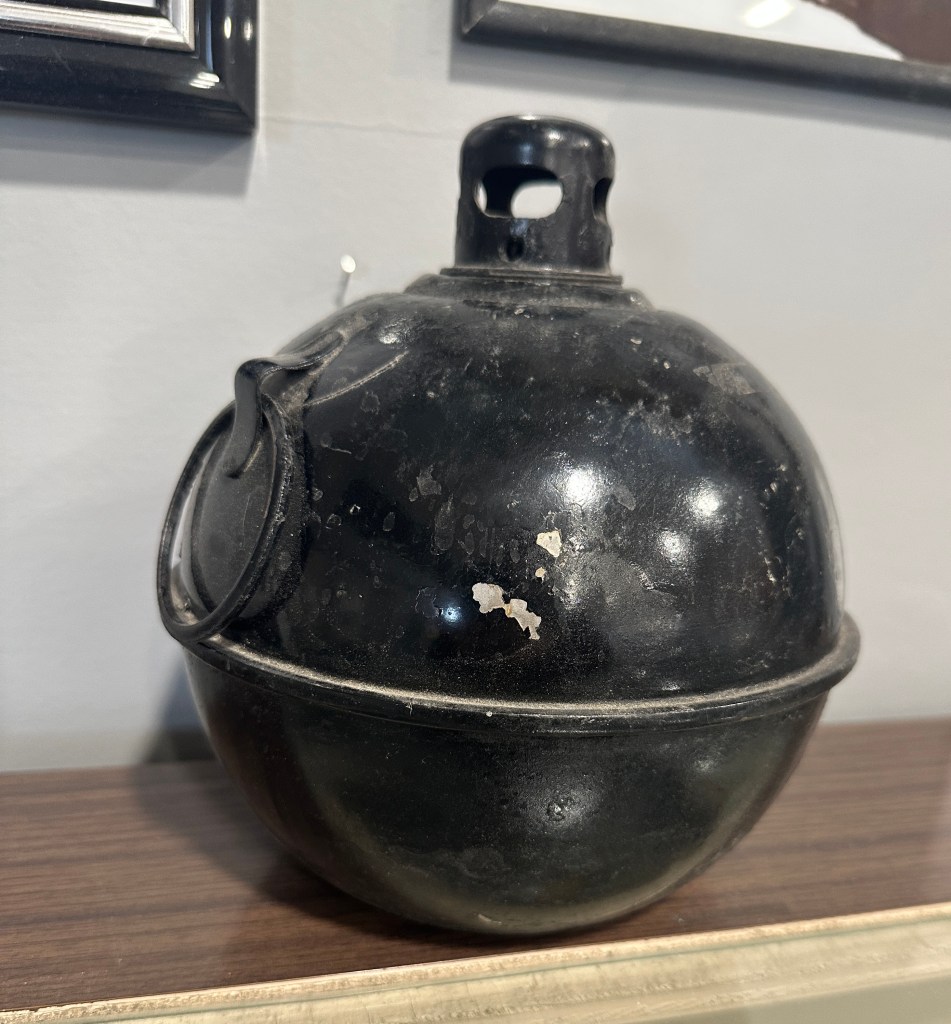
What are flare pots you may be asking? Flare pots were used in WWII during night training or missions for pilots flying aircraft (Canadian War Museum, 2001). They would sit on the runways about 200 feet apart on both sides and they would be filled with gasoline or oil (Canadian War Museum, 2001). These pots had the important job of assisting pilots to see the runway in order to safely land their aircraft at night (Canadian War Museum, 2001). They required a lot of care and attention from service-members on the ground; if they went out, someone would have to go out and relight them (CBC, 2015).
Flare pots may sound nifty at first, however, upon further research, there were some minor issues with the flare pots with their design discovered. Flare pots were increasingly vulnerable to wind blowing them out from either crosswinds of the prairies or the aircraft themselves during take-off (Canadian War Museum, 2001). One solution that was discovered to mitigate this was that only one lane of lights would be lit (Canadian War Museum, 2001). This may sound like a reasonable solution, but the problem for pilots was determining which side the tarmac would be on for one string of lights on the ground (Canadian War Museum, 2001)! If you missed the tarmac, you may end up going into the infield, which probably made for an even bumpier ride. Another issue with the flare pots is that they were difficult to see as pilots could only make them out from about one and a half kilometers away (Alison, 1964). This means that it left a pilot very little time to make any necessary corrections for landing at night time. If anything, the flare pots create a narrative that allows us to view just how profound the risks of being a pilot were back in WWII, regardless if you were “in action”, training or transportation.
One thing is for certain, even though the flare pot sitting in our collection is one of the many representations to symbolize the remnants of WWII, these little pots also have been shown that in times of crisis can still symbolize heroism during peace time as well. One news report from the Canadian Broadcasting Corporation (CBC) noted that the small community of Pangnirtung, Nunavut, experienced a power outage in 2015. At the time of this incident, pilots were trying to conduct a medevac for a patient seeking medical care (CBC, 2015). The airport, in response, had to send out someone to place and light the flare pots so that pilots could see the runway (CBC, 2015). Regardless of whether you think flare pots are an artifact of the long forgotten past or a contemporary hero in times of crisis, they are one of those interesting yet essential items for airfield operations that still continue to have a resounding impact even to this day in peaceful times, lighting the way home for pilots in Canada.

