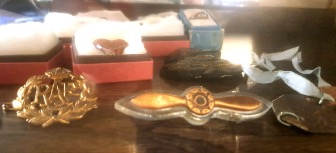
This post is by one of our summer workers. Whitney M. Hodgins is a Master of Arts Student at Athabasca University.
Picture this: your loved one is going to war. You are left with an overwhelming sense of uncertainty. Will they come back or will they be injured or killed in action? Naturally, you do not want that person to be put in harm’s way fighting against the Axis. Yet, you let them go knowing that while you are on the homefront, you are being as patriotic as your loved one on the battlefront. Months go by, your only contact is letters back and forth when they are in a position to write to you. You may even send care packages or help others do the same for their loved ones. Then one day you visit the post office and there is a small package addressed to you! Inside is a letter, as well as a small heart shaped necklace (Canadian War Museum, 2023). Your loved one writes explaining that after shooting down an Axis plane in a dogfight, they salvaged a piece of the cockpit window to fashion a heart-shaped necklace just for you. A truly romantic gesture. As you place it around your neck, you feel a sense of pride—knowing not only that they are safe, but that they are fighting with honour for Canada and the Allied forces.
So what exactly is sweetheart jewelry? Sweetheart jewelry has one predominant purpose; it was to symbolize both the connection of the wearer and the separation they had to their loved ones fighting overseas (Canadian War Museum, 2023; National Museum of American History, 2014). These tokens of affection were primarily given to women who were deemed to be a wife or sweetheart to that service member, and those women did not need to be women from Canada (CBC, 2025). Jewelry did not restrict itself to simply necklaces, a loved one could also receive brooches, lapel pins, and other sorts of sweetheart art (National Museum of American History, 2014). These pieces of jewelry were popular not just in WWII but also were very popular in WWI (National Museum of American History, 2014). These pieces of jewelry were so popular that they also caught the attention of the federal government in WWI (Government of Canada, 2026).
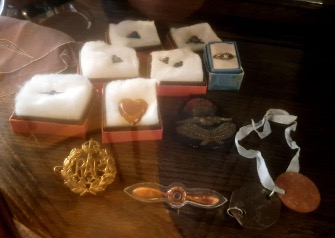
The government of Canada had decided that they would implement an Excise Act Tax on luxury goods, specifically for jewelry made out of precious metals (Government of Canada, 2026). Tin was considered one of the metals needed for the war effort and in response to cheap jewelry and its popular demand in war times, the government restricted metal use in fine jewelry by implementing taxation rates on these items (Canadian War Museum, 2023). The jewelry that the servicemen created was not made of these precious metals, but instead was made out of Plexiglas. Plexiglas, was a clear, solid plastic sheet, created by the Rohm and Haas Company, that had risen in popularity during the 1930’s for both the Allies and Axis (Science History Institute Museum & Library, 2026). By doing so, a service member not only sent their love a piece of jewelry, but they also avoided paying the luxury tax while crafting their love in the chaos (Canadian War Museum, 2023). Additionally it was patriotic as the plexiglas that these were made out of could come from planes that were shot down by a recipient’s loved one in battle, demonstrating the courage the service member possesses (National Museum of American History, 2014). This may be an artifact filled with a complex and political history, but at the same time one cannot lose track of the fact that a service-member altruistically wanted to say proudly, “from the cockpit with love”.

