Another interesting post by summer student, Rory. This is Rory’s second summer working for the CATPM, he is a Music & Political Science student at Brandon University.
Note on Methodology: This blog post examines a recently acquired General Electric Beacon by analyzing attached identifying information related to the artifact and utilizing digital tools, such as Google Lens, recently introduced to me by the CATPM archivist. These sources enabled me to infer the artifact’s origin and historical context through consultation with relevant online histories and archival databases to the best of my ability.
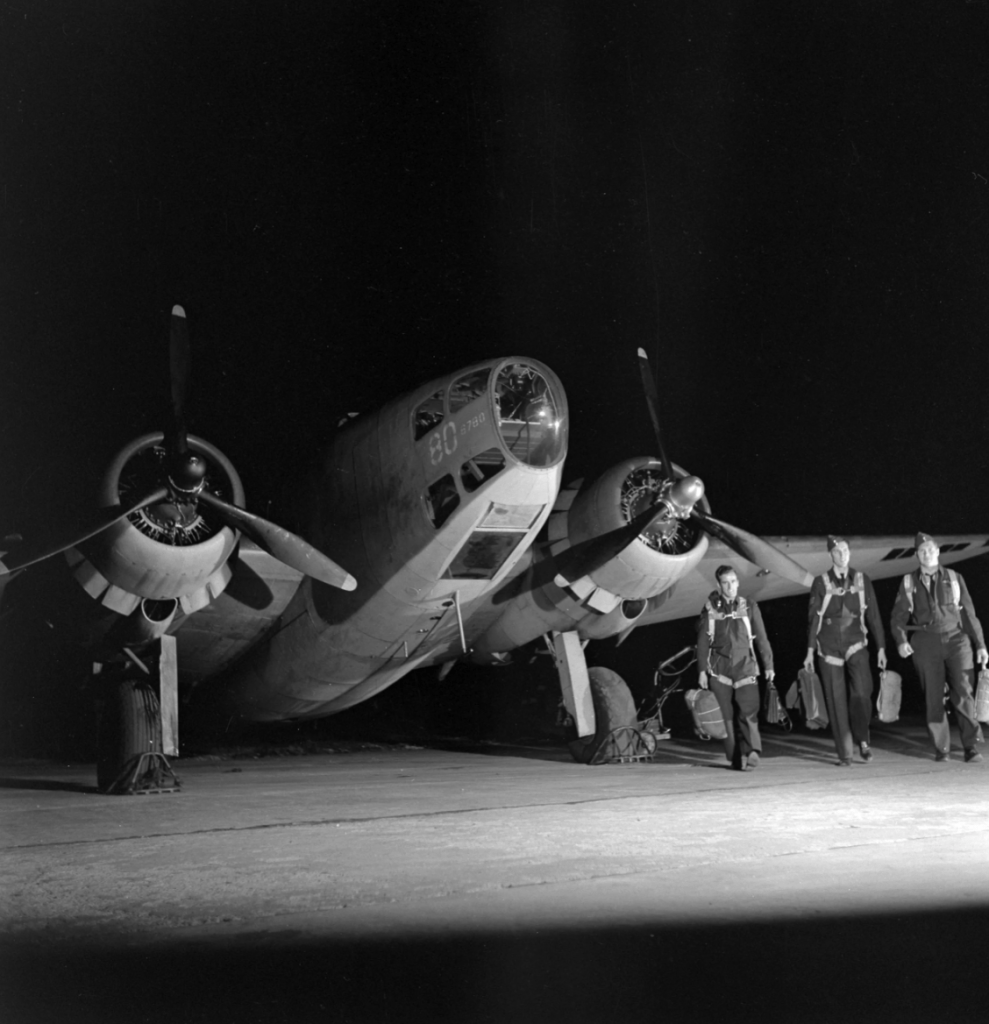
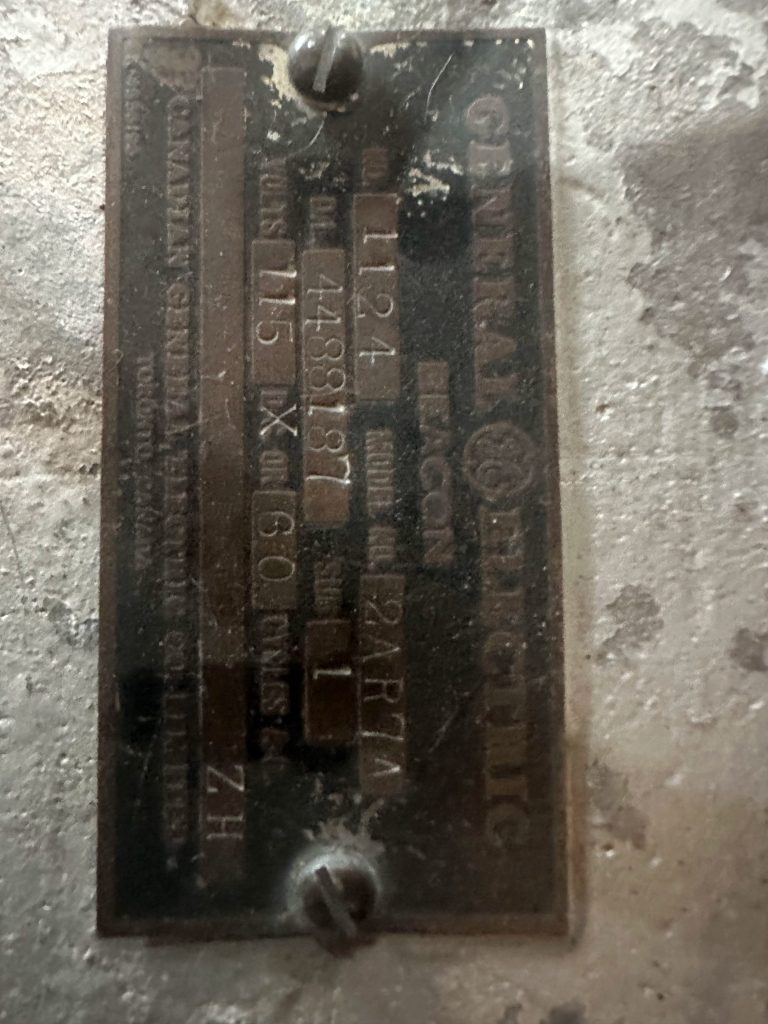
In the early decades of flight leading up to the Second World War, navigating the skies was a daunting task, let alone in the dark of night. Before modern tools like advanced radio operation and GPS, pilots relied on physical chains of lights to find their way. A recently acquired artifact in the CATPM hangar, a General Electric Beacon (No. 1124, Model No. 2AR7A), reflects the legacy of Canadian wartime industry. The Canadian General Electric Company was both a major player in military and civilian life during WWII, manufacturing millions of appliances in Canadian homes and vital infrastructure for the war effort. (York University)
Rotating beacons developed by the General Electric Company, often featuring durable construction and powerful lamps, were spaced along routes, and some could be seen up to 40 miles away (Smithsonian National Air and Space Museum). Based on an official guide by General Electric for all of their appliances, I believe that this unit was manufactured in August 1944, which makes it a part of General Electric’s storied wartime production history. (“GE Appliance – How to Determine the Age or Manufacture Date”)
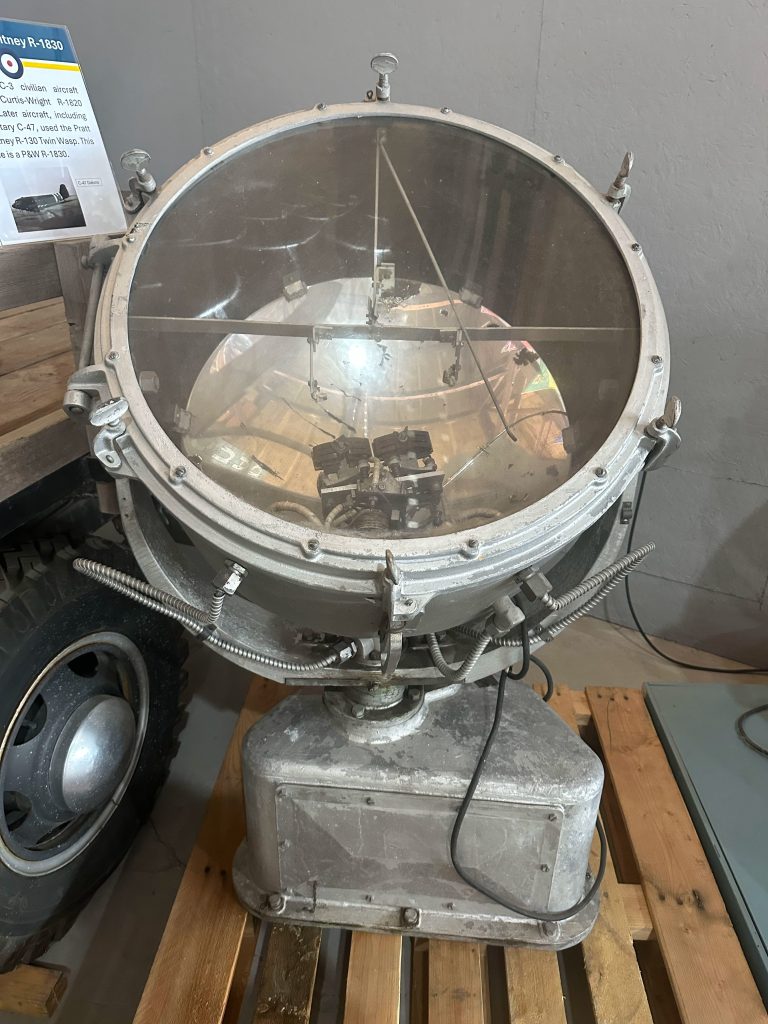
corner of the CATPM hangar.
The origin of beacons for aviation began in the 1920s and 30s, building upon the new development and installation of traffic lights across the United States with the goal of assisting pilots with visual navigation. (Onondaga Historical Association) Additionally, large concrete arrows were often built on the ground around beacons in the chain, transforming aviation from a strictly daytime activity to permitting flight during the dark. As a specialized “aerodrome beacon,” this artifact was used to identify the location of an airfield, although beacons exist for other purposes today, such as checkpoints for Bluetooth inventory with high-value equipment (ELA Innovation). The significance of the aerodrome beacon lies in its capacity to provide crucial visual confirmation for pilots returning during poorer visibility, directly enhancing flight safety by reducing the risk of disorientation or accident during night or inclement weather. By using a variety of patterns and colours, beacons indicate the exact location of airfields while also communicating important information about the airfield itself (Transport Canada). During the British Commonwealth Air Training Plan, these beacons represented a technological advancement that enabled more rigorous and flexible flight training schedules, allowing pilots in Canada to operate safely regardless of daylight or weather conditions. Although airport beacons became less central as new forms of navigation technology emerged, their continued use reflects their enduring importance in providing navigational support and the development of aviation infrastructure.
Additionally, while this Beacon represents General Electric’s contribution to lighting and appliances, it is an even larger part of their much larger history of aviation innovation during the war. A subsidiary of General Electric, GE Aerospace traces its roots to more than 100 years ago, beginning with innovations for aviation such as the turbo supercharger in the 1910s. (General Electric) In the United States, in 1941, GE built the I-A engine, the first American turbojet, and by the same year that this beacon was made, another engine (the J33) was used to power the Lockheed P-80 Shooting Star. Today, GE is still a major player in the aviation industry, including manufacturing the engines for Boeing 737s.
As radio navigation and GPS have become the standard, aerodrome beacons have gradually become less used than in wartime. However, some beacons are still used today, such as in mountainous regions of the United States and Canada. (Military History Wiki) Ultimately, these surviving artifacts of the Commonwealth Air Training Plan are a reminder of the vital innovation and infrastructure that allowed the members of the plan to train on such complicated aircraft at such a young age and supported them through flying at all hours of the day, and the Museum is thrilled to welcome this artifact to our hangar.

