Whitney M. Hodgins is a Masters of Arts Student at Athabasca University focusing on Social & Heritage History. Whitney is a student summer worker at the CATPM, this is her third post for us.
Some folks might have noticed my usual spot at the Commonwealth Air Training Plan Museum was empty during the first week of June. That is because I traded a week of talking about World War II aviation history for stepping inside a modern aircraft myself, taking flight all the way to Charlottetown, Prince Edward Island. While PEI is famously celebrated as the birthplace of Confederation, it recently served as the backdrop for my own professional milestone: attending the Canadian Historical Association’s (CHA) Annual Meeting. Trading the museum hangar for academic panels was an incredible opportunity, and I am excited to share how this week of professional development gave me a whole new perspective to bring back to our vintage wings in Brandon.
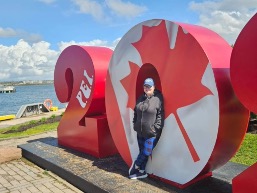
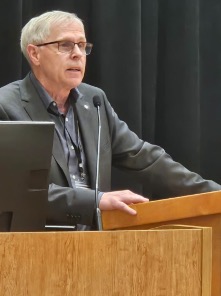
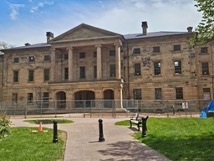
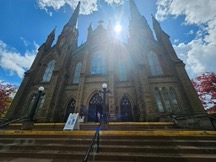
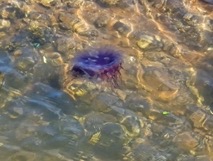
But as any museum buff knows, you cannot visit a historic city without doing a little boots-on-the-ground exploring. I explored downtown one afternoon. When not visiting the markets on cobble stone streets, I was enamoured by visiting St. Dunsten’s Basilica. A towering example of high Victorian Neo-gothic style architecture, St. Dunsten’s Basilica is not just a significant place of worship for many, it is also a National Historic Site! I also visited Province House, where John A. McDonald and company would attend the Charlottetown Conference, this building also happens to be what is now today’s provincial legislature for PEI. This building is also a National Historic Site (NHS) currently under high levels of renovation, so I could only enjoy it from afar. I also got the pleasure of seeing the bay and seeing a swarm of Lion’s Mane jellyfish in their natural habitat as apparently there is a peak time to witness this phenomenon in nature (so I was unsuccessful in touching the bay with my toes). In addition to being a massive tourist of other historical sites and showing off my CAPTM merch, I also attended many panels at the CHA Annual Meeting, where other historians or graduate students like myself presented their current research, thesis’, or collaboration work with other universities. The keynote for the conference was none other than Dr. Edward MacDonald, Professor Emeritus at the University of Prince Edward Island. He gave this year’s keynote titled, “Reckoning with Place: Region and the Role of the Historian in Troubled Times”. There was a lot to unpack in his address, but what took me back and what really got me excited is how he challenged everyone in that room to pick up more local history and to go back to our roots as historians where local and regional history is used to contextualize greater national and transnational narratives. He argued that you cannot do history justice without bringing in the places, people, and local narratives into the consciousness of the time period we are researching but also in a museum context, we have the important job of reiterating and retelling those narratives from that time period.
MacDonald caught me in his web of logic by talking about how as a young historian being frustrated with the fact that PEI back then was viewed as just simply the birthplace of confederation and this narrative, although important for all of Canada’s past, completely neglected the rest of PEI’s immense history. In many regards, Westman gets viewed in a similar light by those not aware of our communal past, that we are boring as an agricultural community is something that both tourists and everyday citizens discuss. This is where theory of place as a discipline within history has become vitally important. As historians, archivists and museum specialists can probably all agree on, we do not simply talk about the past in a way that brings meaning for the everyday person, we also translate that meaning from the past into language that makes sense for everyone. It pulls in the local narratives that are a piece of our more national and transnational narratives. It puts faces to names and brings meaning to a complex topic that now is becoming part of the long ago past for the future generations of people to walk through these doors. At the CAPTM, we are a museum as well as a National Historic Site. While most NHS’ and museums do many different things to contextualize the past of their own mandates, one thing remains clear, museums and NHS’ are providing that foundation to go back to local and regional histories that historians may depend on for research projects.
As the conference continued on, I networked with a lot of individuals at various levels in their academic careers, from undergrads to emeritus professors. Ultimately, trading the hangar for history panels proved to be an invaluable experience. Navigating my first CHA Annual Meeting felt less like a departure from my regular duties and more like an essential expansion of them. Armed with a deeper appreciation for the “theory of place,” a stack of new books purchased from the book fair, and fresh perspectives from across the country, I am eager to apply these insights to our work in Brandon. While this journey served as a fantastic student’s guide to the CHA, it also reminded me that every vintage wing and local story we preserve at the museum plays a vital role in flight-mapping the broader narrative of Canadian history.


One thought on “Trading the Hangar for History Panels: A Student’s Guide to the CHA”