This post is by summer student, Rory M. He is a music student at Brandon University, this is his second summer with us.
The Avro Arrow seems to be a near-mystical phenomenon in the world of aviation, and I have witnessed this lingering hold firsthand. During my time as a summer student, guests have shared countless memories, conspiracy theories, and stories about the Arrow, and much to my surprise, Arrow merchandise is the top seller of all aircraft in the gift shop. This fascination leads to the core question of this blog post: what is all the fuss about the Avro Arrow? Is it a resemblance to our current geopolitical tensions with the United States? A grand conspiracy that took place beneath Canadians’ eyes? Or was it simply a massive project that put the federal government too deep in the red? To find out, I dove into various news articles, and two books: Fall of an Arrow by Murray Peden, and Requiem for a Giant: A.V. Roe Canada and the Avro Arrow by Palmiro Campagna. In this post, I hope to have uncovered why the Avro Arrow remains so fiercely alive in Canadian aviation history.

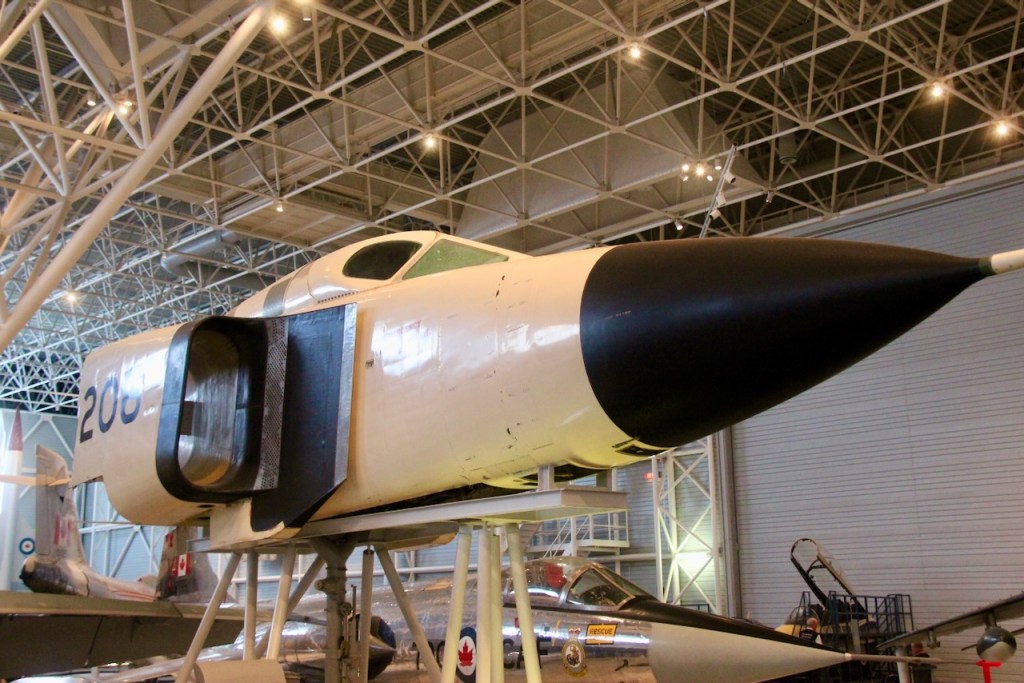
The story of the CF-105 Avro Arrow is not only one of innovative engineering, but also of national ambition and a sudden, controversial cancellation. The project began in the mid-1950s as the RCAF issued a set of requirements for an aircraft project that seemed nearly impossible, needing an interceptor capable of flying at more than 50,000 feet to patrol the vast, frozen Arctic. (Campagna) Avro Canada’s response was a technological leap that met these requirements, featuring a delta-wing design that seemed structurally impossible to the engineers of the time (Fall of an Arrow).
Because traditional parts wouldn’t fit the aircraft, Avro’s team had to invent many systems to help the aircraft function, including tandem pistons, high tensile steel alloys, as well as a technology known as “fly by wire.” (Peden) The true innovation of the project, however, was the Orenda Iroquois Engine. As written in Requiem for a Giant, much like the Merlin engine of WWII, this engine was a huge step in Canadian aviation. With titanium construction to save weight, it could produce more than 26,000 pounds of thrust, more than four times that of some of the American jets of the time.
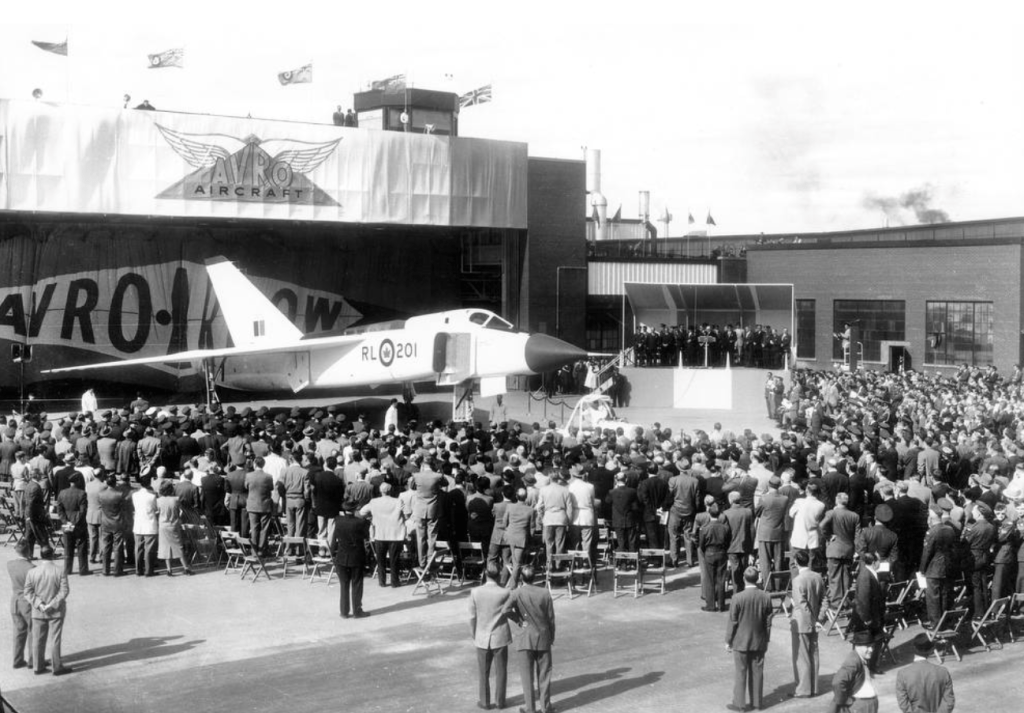
One of the sources of conspiracy within the aviation community about the Arrow is a “cruel coincidence” of historical events. (Campagna) On October 4th, 1957 as Avro rolled out a prototype of the aircraft to an ecstatic crowd in Malton ON on the same day, the Soviet Union launched an operation which would change global defence priorities overnight, Sputnik I (CNN). Suddenly, Canada’s primary threat was no longer manned bombers which the Arrow was built to defend from, but rather ICBM’s (Intercontinental Ballistic Missiles). From this day, the Arrow project had a shift in perception by the Canadian defence network, beginning to view the Arrow as a “beautifully engineered dinosaur.” (Skeptoid with Brian Dunning)
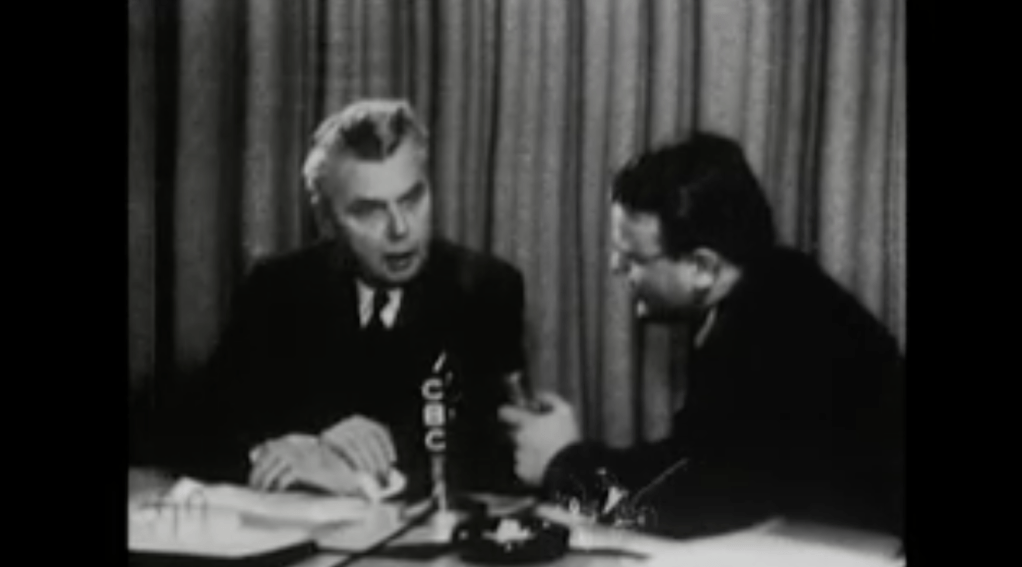
Soon after this change in defence priority, the end was near. The Arrow’s last blow was dealt on February 20th, 1959, a day colloquially known as “Black Friday.” (Fall of an Arrow) Prime Minister Diefenbaker addressed Parliament and announced the immediate termination of the project, effectively relegating Canada’s aviation industry to the “industrial minor leagues.” (Fall of an Arrow)
The impact led to immediate devastation in Canadian aviation. Roughly 14,000 skilled employees at Avro and Orenda were fired instantly, with some hearing the news over the factory’s PA system. Including subcontractors, this decision resulted in job losses for more than 50,000 people. (CNN) These skilled Canadian aviation elite fled to the United States, and a group of 32 top Avro engineers were recruited to NASA, becoming leads on the Mercury, Gemini, and Apollo projects. (CNN)
To add insult to injury, in a head-shaking move, the Arrow was completely erased in a move which Fall of An Arrow deems “vandalism.” Five completed, flyable aircraft were cut into pieces with blowtorches, blueprints shredded, and assembly jigs melted down. (Peden) This destruction was responsible for the “Ghost Plane” theory, which suggested that the prototype Arrow was secretly flown off the tarmac to a hidden hangar before demolition occurred. While there were aerial photos showing the plane missing from the tarmac, a more likely reality is that it was moved into a different hangar so that technicians could remove confidential electronics. (Skeptoid with Brian Dunning). In fact, authentic Arrow parts have resurfaced over the years, including an ejection seat on eBay a few years ago. These pieces were likely smuggled as “souvenirs” by heartbroken workers who didn’t “want their life’s work to be turned into scrap metal.” (Skeptoid with Brian Dunning)
Another popular myth of the Arrow often blames American sabotage for its death, but the sources that I have read tell a more complicated story than simple American influence. While it is true that the U.S and U.K decided to protect their own markets by not buying into the Arrow project, its true killer was its price tag, which was believed to have cost more than $470 million (Peden). This project may not have been in the cards, as the Diefenbaker government inherited a massive deficit and had recently joined NORAD, which required a quarter-billion-dollar commitment to missile defence upgrades (CNN). Simply, Canada could not afford the pricy Arrow project as well as missile defence
Based on these factors, I believe that the prolonged interest of the aviation community in the Avro Arrow is a bit of national heartbreak about what could have been. Understanding that our outstanding technology was stolen by another nation, killed by a politician, or part of a larger conspiracy is quite entertaining. However, in my estimation, the truth is that geopolitical tensions of the Arrow’s time period were too great for such an extravagant red line on the national budget and a middle-sized country like Canada was unable to support it. Ultimately, I apologize if you were looking for a confirmation of a conspiracy theory, but I have not seen adequate evidence to see it myself.

