Whitney Hodgins is a Master of Arts student at Athabasca University focusing on Heritage and Social History.
Picture this: You are tending to your field as a farmer when all of a sudden you see a shadow on the ground approach you in the distance. When you look up into the sky, you see this round dark orb blocking out the sun with a weird looking shaped item floating beneath it on strings. It is approaching the ground… then you realize it is approaching you! You back up and then turn to run as fast as you can away from it. When it lands, it glides quietly to the ground and nothing happens. You approach it apprehensively to get a better look at the unknown object that landed in your field and you come to find a missile tied to this balloon. You immediately run back to your truck, drive back to the farmhouse and call the authorities.

What that farmer saw was something that is known as a Fu-go Balloon Bomb. The term Fu-go is translated roughly in Japanese to mean “Code Balloon” because Fu was short for Fusen*. These balloons were in response to the Doolittle Raiders against Tokyo in 1942 by the Allies to confuse and impede the production of weapons from the Japanese (Mikesh, 1973). The Japanese had been in the process of creating these balloons well before WWII in 1933 under their “Proposed Airborne Carrier Research and Development Program”, where the main mandate was to research and carry out the development of new war weapons (Mikesh, 1973). This program was effectively dropped in 1935, however, the Fu-Go never fully shut down because it showed promise at the time (Mikesh, 1973). Then again, anything sounds better than the Ray-do, their death ray the Japanese attempted to create (Mikesh, 1973). These balloons were completely unmanned. When considering the human cost of war, this would have been considered a win for the Axis Forces as a way to save man-power in WWII efforts as by now their man-power is starting to dwindle and morale is beginning to drop.
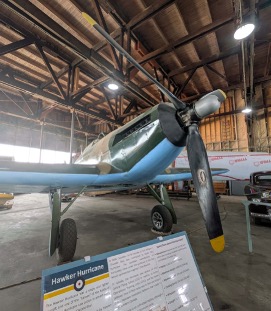
In November 1944, 9,000 of these balloons were released into the jet-stream to bring the battlefront to the homefront (US Department of Agriculture, 2026). The Japanese’ primary objective was to start mass forest fires across the continent as a way to pull resources back to the homefront (US Department of Agriculture, 2026). Only 1,000 of these balloons would make it to North America and only 342 would be spotted (US Department of Agriculture, 2026). The Allies responded with two things, mass censorship on the balloons themselves and Operation Firefly. Firefly involved the US Military, the Canadian Military, and US Forest Services. This operation had been tasked with spotting the Fu-go Balloon Bombs, shoot them down before they have a chance to land, and if they land, dispose of them immediately to save the natural resources and civilians in the area (US Department of Agriculture). Which brings me to the aircraft used for this operation. Although the US Military used their own aircraft, Canada primarily used Hawker Hurricanes and KittyHawks to intercept these balloons (Hangar Flight Museum, 2026).
Here at the Commonwealth Air Training Plan Museum, our collection includes a partially restored Hawker Hurricane. Hawker Hurricanes are renowned for who assisted in the building of over 14,000 of them. Elsie MacGill, also known as the Queen of the Hurricanes, was a Canadian woman who was the Chief Aeronautical Engineer that headed the production of these air-craft in WWII in Canada (Canadian Encyclopedia, 2007).
Of course, sometimes these bombs snuck past air force operatives and bombs would touch the ground. Once they did, those involved with Operation Firefly would need to go deal with the bomb by interviewing those who spotted these incendiary balloons land (Halliday, 2009). But even then, not every bomb was dealt with in time. On May 5, 1945, 6 Oregon citizens died when a Fu-go bomb landed nearby and exploded where they were having a family picnic (Halliday, 2009; Uenuma, 2019). This ultimately would be when the censorship ban would be lifted as the US Government had to warn civilians of the dangers of these bombs (Halliday, 2009).
The Fu-Go program stands as a fascinating, albeit deadly, piece of World War II history—a testament to desperate innovation when the war reached a stalemate. While the tragic loss of life in Oregon forced the declassification of these weapons, the joint defense efforts of the U.S. and Canada successfully mitigated much of the intended destruction. Today, aircraft like the Hawker Hurricane and the incendiary balloon featured in our collection at the Commonwealth Air Training Plan Museum in Brandon serve as a physical reminder of this unique, trans-Pacific airborne threat.
* This may not be an accurate translation. I do not speak or know Japanese. If the translation is incorrect, feel free to contact us at the CAPTM and we will happily correct it to reflect the translation accurately.
 Commonwealth Air Training Plan Museum & RCAF WWII Memorial